
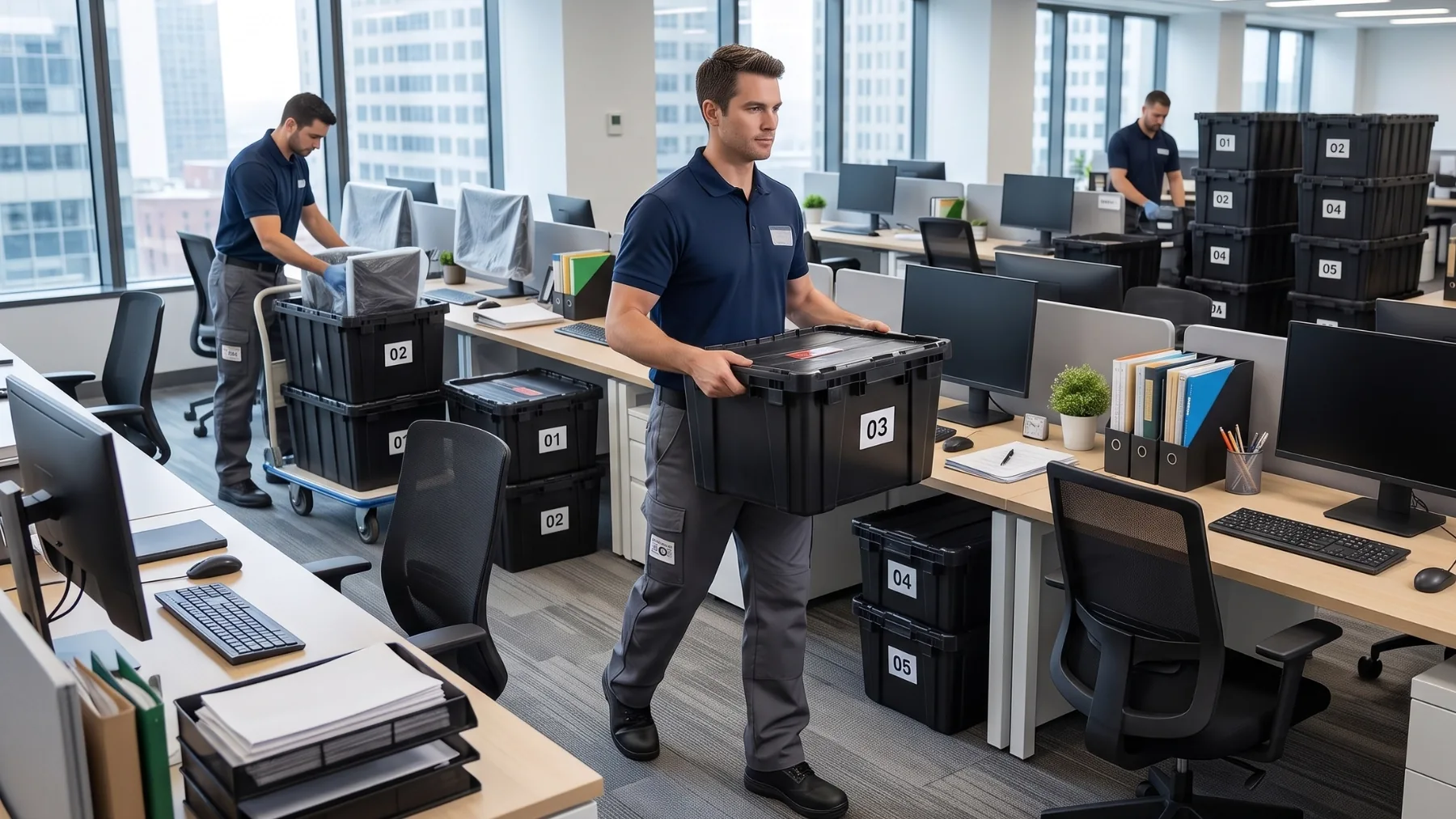
A residential move is measured in boxes. An office move is measured in hours of downtime — and that is the only unit management cares about. Everything below serves to bring that number down, not to fill containers faster.
Split by team, not by floor
The classic mistake is emptying the building from top to bottom. It is efficient for the movers and expensive for the business: every floor moved cuts across several departments at once. Move one complete team at a time instead. It stops for half a day, everyone else keeps working, and nobody waits on a colleague still in the old space.
The workstation, not the object
A workstation travels together: tower, screens, peripherals, work in progress. At the other end you rebuild a complete desk in minutes instead of matching keyboards to computers. It is also what prevents the next-day call about a power cable left in another bin.
Label by destination, never by contents
A bin marked “files” tells the person carrying it nothing. A bin marked “3rd floor — accounting — desk 12” gets put down without a question. The rule holds for everyone: the label answers “where it goes”, not “what is inside”.
What must be sealed has to be sealable
Personnel records, client files, financial documents: these are the only containers where you need to be able to prove they were not opened in transit. A closed lid does not prove it; a tie cut on arrival does. Plan one per bin concerned, and note who seals them.
Plan the pickup, not just the delivery
The question that always comes up afterwards is the same: “where do we put the empty containers?” In an office they stack in a corridor for two weeks and get in everyone's way. Set the pickup date at the same time as the delivery — it is a line in the contract, not a call to make later.
A one-hour rehearsal beats a ten-page plan
Before the day, walk the route empty with one person from each team: elevator, loading dock, corridor, doors. In an hour you will find what no plan announces — a doorway too narrow, an elevator that must be booked, a dock shared with another tenant. That is where the downtime hours are won.